
How to Buy HR Tech Like a Pro (Free RFP Toolkit )
The Decision Management Toolkit for HR Tech
Buying HR technology requires a different level of discipline than most internal software purchases.
HR typically operates as a cost center. The tools HR purchase are not generally associated with revenue generation, which means every purchase must clearly demonstrate ROI, time to value, and operational leverage. Finance, IT, Legal, and executive stakeholders will all evaluate the decision through a risk and return lens.
High-performing teams recognize this dynamic. They do not rely on demos and informal comparisons. They run a structured process that clarifies the problem, aligns decision makers, and evaluates vendors against defined requirements.
This article introduces a four-part Decision Management Toolkit designed to help HR teams run that process professionally and consistently.
What’s Included in the HR-Tech RFP Toolkit
1. Problem Statement Intake Tool
Why do you need a problem statement when buying HR Tech?
The Problem statement intake tool gathers key information to summarize the problem the business is facing to help justify the expense to internal stakeholders, as well as define the scope of the problem to prospective vendors.
Why is a Defining a Problem Statement for HR tech important?
There’s a lot of overlap with different HR Tech tools, especially with the rise of “all-in-one” solutions that have a lot of features. A crisp scope reduces noise in your RFP, justifies price vs ROI, and helps evaluate craft a total solution.
The Problem Statement forces teams to articulate:
What is the operating problem?
Who does it affect?
Where does the current process break?
Why cannot the issue be solved using existing systems?
This document prevents premature vendor evaluation. It ensures the buying conversation starts with operational design rather than feature comparison.When done correctly, this document becomes the anchor for Finance and executive discussions. It explains why this purchase exists and what measurable outcome it is expected to improve.
2. HR Tech RFP Executive Summary
The RFP Snapshot is the executive one pager for to summarize everything from the problem, to perspective vendors, internal decision makers and a timeline for the process.
Why do I need an Executive Summary for my HR Tech Purchase?
HR tech purchases need multi-stakeholder buy in. HR tools are unique in that they are used by everyone, not just HR. Hiring managers, budget owners, finance, recruiters and other stakeholders all participate in HR tech tool usage, which means buying buy in across stakeholder
What does the Unicorn Talent HR-Tech Exec Summary include?
RFP owner - Who’s running the who
Problem summary - What’s bad, and how do I quantify it?
Solution description - What happens when we get it right?
Impacted teams - Who are the key teams impacted?
Decision makers - Who makes the call?
Budget parameters - How much will it cost, and is it planned?
Expected time to value - How fast after the purchase will we see a return?
RFP Timeline - When will key process steps happen?
Target vendors - Which vendors, at what price?
This document ensures stakeholders understand scope, ownership, and expectations before vendor conversations deepen.
It also prevents RFP drift. By capturing time to value and sequencing early, teams reduce the likelihood of selecting a tool that cannot realistically be implemented within organizational constraints.
3. Vendor Information Form
The Vendor Information Form standardizes vendor inputs. You’ll send this, along with the key assessment categories to the vendors as a part of the RFP process.
Why is a Vendor Information Form Important?
Vendor information forms are like their application to work for you, with a summary of their company & experience as a source of truth for what to expect. The include information that’s important for eligibility (like security clearance or ability to operate in your country)
What Information Should a Vendor Give During an RFP?
Each vendor completes the same structured top sheet, allowing clean side-by-side comparison. Instead of relying on slide decks or live demos alone, teams gather consistent data across:
Company background
Product positioning
Implementation model
Support structure
Commercial structure
This eliminates noise and reduces the risk of decisions being influenced by presentation style rather than substance.
4. Key Assessment Categories for HR Tech RFP
This is the core evaluation engine.
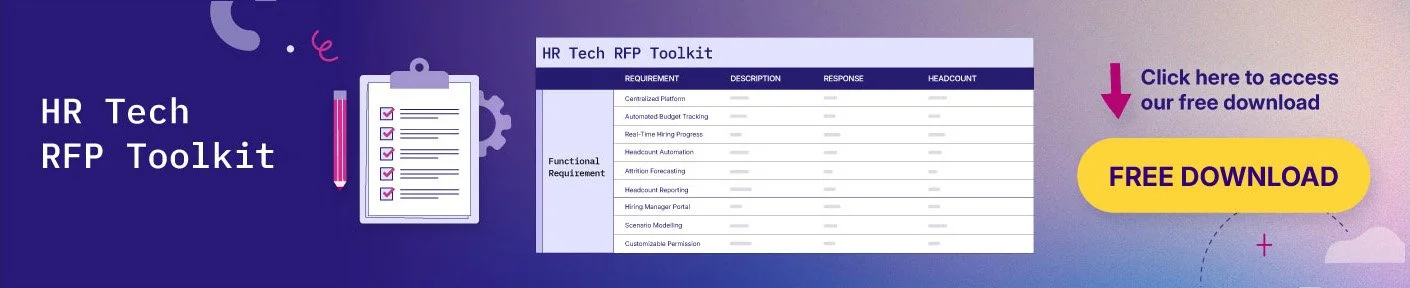
The Key Assessment Categories document outlines every functional, technical, integration, security, and implementation requirement relevant to the decision.
For each requirement:
The company defines what matters.
Vendors indicate whether the capability exists.
Vendors provide additional detail in a structured format.
Drop-down selection combined with qualitative description creates both quantitative scoring and contextual understanding.
This approach enables:
Consistent evaluation across vendors
Clear documentation of tradeoffs
Defensible final recommendations
It also ensures IT and Security stakeholders have visibility into requirements before contracts are signed.
Best Practices for HR Tech RFPs
Limit the Vendor Pool - Fewer vendors evaluated deeply is better than many vendors evaluated superficially.
Require Written Responses FirstWritten inputs reduce demo bias and improve comparability.
Align on Decision Criteria Early- Weighting functional, technical, risk, and commercial considerations upfront prevents last-minute debates.
Tie Evaluation to Implementation Reality- A tool is only as strong as its adoption and integration path. Implementation effort and internal resource constraints must be evaluated alongside functionality.
Document the Decision Rationale- Clear documentation builds credibility with Finance and reduces re-litigation later.
HR technology decisions require operational rigor. The cost center dynamic means every purchase must demonstrate clarity of problem, disciplined evaluation, and a realistic path to value.
A Structured Approach to Purchasing HR Tech
Unicorn Talent’s HR tech Buying kid provides four structured documents that guide that process from problem definition through vendor comparison and final recommendation. Teams that standardize their approach reduce variability, align stakeholders earlier, and increase the likelihood that selected tools are implemented successfully.
Download the toolkit and run a professional, repeatable HR tech evaluation process that stands up to scrutiny and delivers measurable impact.